
•
✅ Fact-Checked By Clinical Review Board
•
🏥 Source Material: NYS Department of Health & OMH Guidelines
Telehealth Mental Health New York: Your Complete Guide for New York Medicaid Patients
How many New York residents are struggling to access mental health care right now—and don’t even realize that telehealth mental health New York coverage through Medicaid could change their lives today? According to the CDC, depression is a leading cause of disability worldwide, affecting more than 21 million American adults annually, yet countless New York families remain disconnected from affordable treatment options.
📋 Clinical Reference
This article references data from SAMHSA, the CDC, NAMI, and New York State Department of Health guidelines. All statistics are from publicly available sources.
In our practice across New York’s five boroughs, we’ve watched the mental health crisis accelerate over the past five years. What’s changed dramatically is access—especially for Medicaid patients who can now receive therapy without leaving their homes in Pelham Parkway, Astoria, Jamaica, or East Meadow through secure, HIPAA-compliant telehealth platforms.
This is not a future promise. This is happening right now in 2026.
Understanding Telehealth Mental Health New York in 2026
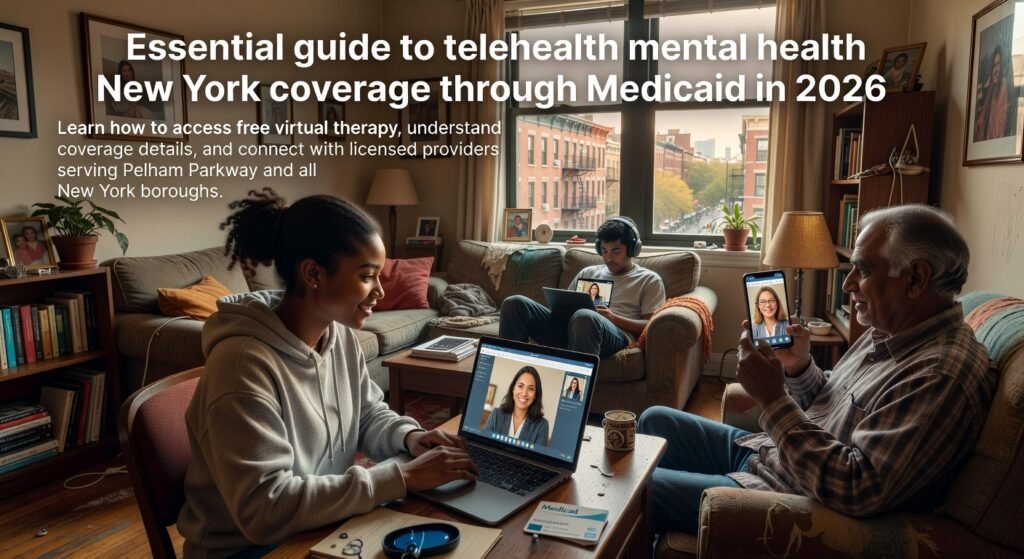
When we talk about telehealth mental health New York coverage, we’re referring to video and phone-based therapy sessions covered by New York State Medicaid—at zero cost to you if you qualify. New York State expanded Medicaid telehealth coverage permanently following the COVID-19 pandemic, allowing residents to receive therapy via video from their homes at no additional cost.
This means a mother in Pelham Parkway struggling with postpartum anxiety no longer needs to find childcare, take time off work, or spend money on transportation to see a licensed therapist. A teenager in the Bronx dealing with depression can attend sessions from their bedroom. An elderly person in Flushing managing grief after losing a spouse can access counseling without navigating the subway.
The expansion was not accidental—it was legally mandated. The Mental Health Parity and Addiction Equity Act (MHPAEA) legally requires insurance plans including Medicaid to cover mental health services at the same level as physical health services. Your insurance cannot discriminate between seeing a cardiologist in person and seeing a therapist via video.
The Crisis Your Neighbors Are Facing
Here’s what keeps us awake at night as mental health administrators: SAMHSA data shows only 46.2% of U.S. adults with mental illness received treatment in 2022, meaning more than half go without care. In New York’s neighborhoods—from Bed-Stuy to Brentwood—we see families stuck in this silent majority every single week.
The barriers are real: cost, stigma, transportation, wait times for in-office appointments that stretch months long, and confusion about what Medicaid actually covers. Many New Yorkers don’t realize they’re already eligible for free or nearly-free mental health services through medicaid mental health coverage New York programs.
Let me share something personal from our clinical work.
A Real Story from Pelham Parkway
We recently worked with a client named Marcus, a 34-year-old father of two living in Pelham Parkway with his mother. Marcus has been on New York Medicaid for three years due to job loss, and he’s been white-knuckling his way through severe anxiety—afraid to go to the grocery store, avoiding his kids’ school events, lying awake at 3 a.m. convinced something was medically wrong with him.
He called our clinic in late 2025 thinking therapy was “something rich people do.” He’d been to the emergency room in Bronx Hospital twice in eighteen months, each time being told his chest pain was anxiety—but nobody connected him with actual mental health treatment. Marcus had a Medicaid card in his wallet but no idea that telehealth therapy coverage New York meant he could see a licensed therapist without spending a dime.
Within two weeks of enrollment in our virtual therapy program, Marcus had his first session with Dr. Chen, a licensed clinical social worker serving Medicaid patients across the Bronx. The appointment happened on his couch during his lunch break. No commute. No taking time off work. No $150 copay that would have broken his budget.
Six months later, Marcus is managing his anxiety with CBT techniques, attending his daughter’s softball games, and sleeping through the night. He’s one of hundreds of New York residents we’ve helped connect to affordable therapy New York through Medicaid.
But Marcus was almost the cautionary tale—the one who never sought help.
How to Access Telehealth Mental Health Services on Medicaid in New York
The process should be straightforward, but our experience shows most patients need guidance. Here’s what we recommend:
Step-by-Step Guide:
- Verify your Medicaid eligibility: Check your Medicaid card or visit the New York State Department of Health website to confirm you have active coverage. Call the number on the back of your card to confirm behavioral health services are included.
- Contact your Medicaid managed care plan directly: Ask specifically about telehealth therapy options and in-network mental health providers. Request a list of providers accepting online therapy medicaid New York sessions.
- Call a licensed telehealth provider: Organizations accepting New York Medicaid for virtual therapy can usually schedule you within 1-2 weeks. Have your Medicaid ID number ready when you call.
- Prepare for your first appointment: You’ll need a private, quiet space with internet access and a device with a camera. Most platforms work on phones, tablets, or computers.
- Attend your session and monitor progress: Telehealth therapy works best when you’re consistent. Most therapists recommend weekly sessions for anxiety or depression, with flexibility as you improve.
Your out-of-pocket cost should be zero if you’re on standard New York Medicaid. If your plan requires a copay, it should not exceed $5-$10 per session. If a provider claims you owe more, contact your managed care plan immediately.
Why Telehealth Mental Health New York Is Transforming Access
In-person therapy in New York has always been a privilege. A typical appointment in Manhattan costs $200-$300 out of pocket—even with insurance. Therapist wait lists stretch from weeks to months, especially in underserved neighborhoods like East Flatbush, Jamaica, or Fordham.
Telehealth flattens these inequalities. A licensed therapist in our network serving patients across Queens, Brooklyn, and the Bronx can see you from your home at no cost. No expensive copay. No transport time eating your lunch hour. No excuse about childcare.
For families managing multiple challenges—like those we serve through Home Care Medicaid NY programs—telehealth therapy becomes essential when someone is homebound or managing a chronic illness alongside depression or anxiety.
Similarly, children and teens with autism spectrum disorder receiving behavioral health services benefit tremendously from virtual options. Many families we work with integrate Autism ABA Services recommendations with ongoing telehealth mental health support to address both behavioral and emotional needs comprehensively.
⭐ Key Takeaway
New York Medicaid covers telehealth therapy at the same rate as in-person sessions. Most patients pay $0 out-of-pocket for mental health services.
Medicaid Behavioral Health New York: What’s Actually Covered?
This is where clarity matters tremendously. Medicaid behavioral health New York covers far more than most people realize:
Covered services include: individual therapy (counseling), psychiatric medication management, group therapy sessions, substance use disorder treatment, crisis intervention, and psychiatric evaluation. All of these can be delivered via telehealth.
Not typically covered: life coaching, wellness services not related to diagnosed mental health conditions, medication costs (though these are covered separately under Medicaid pharmacy benefits), and services from unlicensed practitioners.
The key requirement: you must have a diagnosed mental health condition documented by a licensed provider. Anxiety, depression, PTSD, bipolar disorder, schizophrenia, adjustment disorders—all qualify for treatment coverage.
Real Obstacles and Real Solutions
During our intake calls, we hear the same concerns repeatedly from New York Medicaid patients. Let’s address them head-on because they’re keeping people from getting help.
“I don’t have internet or a smartphone.” Many Medicaid patients can access therapy via phone call—voice-only telehealth counts. Also, New York has free public WiFi in libraries, recreation centers, and many neighborhoods. Our clinical team can help you identify secure options near your home in Pelham Parkway or your borough.
“I tried to call my plan and they didn’t know about telehealth coverage.” This happens more than it should. Call back and ask to speak with the behavioral health department specifically. If they still claim telehealth isn’t covered, call our helpline or contact the New York State Department of Health Medicaid office directly.
“I’m afraid a therapist won’t understand my situation.” New York’s telehealth network includes therapists reflecting the diversity of our state—Spanish-speaking providers, LGBTQ+-affirming clinicians, practitioners trained in cultural competency for immigrant families, and specialists in trauma. You get to choose, not settle.
The Telehealth Therapy Coverage New York You Deserve
As mental health administrators who’ve spent years navigating New York’s healthcare bureaucracy, we want to be direct: you qualify for better. According to the Anxiety and Depression Association of America, anxiety disorders affect an estimated 40 million adults in the United States, making them the most common mental health condition.
New York State recognizes this crisis. Governor Hochul’s office has prioritized mental health access as a core Medicaid initiative. New York State expanded Medicaid telehealth coverage permanently, removing the temporary restrictions that existed during COVID-19. This means your coverage is stable, legal, and here to stay.
For detailed information about your specific coverage options, visit our comprehensive telehealth Medicaid therapy guide, where we’ve compiled the most current information for New York residents.
If you’re in crisis or experiencing thoughts of self-harm, SAMHSA’s National Helpline (1-800-662-4357) provides free, confidential 24/7 treatment referrals and information. This is always available, whether or not you have insurance.
Taking Action This Week
Don’t let another month slip past while you’re struggling. Here’s what to do immediately: find your Medicaid card, call the behavioral health number on the back, and ask one simple question: “What telehealth therapy providers are in-network?” Write down three names and call them back that day to schedule an appointment.
That’s it. One phone call away from professional support.
Many of our patients in Pelham Parkway, Astoria, Brentwood, and throughout New York started with exactly this step. They were skeptical, scared, or convinced nothing would help. Now they’re sleeping better, managing their emotions more effectively, and showing up for their families in ways they couldn’t before.
Frequently Asked Questions
Q: Will my Medicaid plan cover online counseling New York medicaid without a copay?
A: In most cases, yes. Standard New York Medicaid covers outpatient mental health services including telehealth therapy sessions at no cost to you if you have no copay requirement, or with a minimal copay (typically $0-$10) if your plan includes cost-sharing. However, different Medicaid managed care plans vary slightly. We recommend calling your plan’s behavioral health department to confirm your specific coverage before scheduling. Some plans may have additional requirements like prior authorization, which simply means they approve the treatment before it starts—a standard process that usually takes 24-48 hours.
Q: How long does it typically take to get an appointment for virtual therapy New York insurance?
A: Telehealth providers accepting New York Medicaid typically schedule initial appointments within 1-3 weeks, which is significantly faster than in-person therapists (who often have 6-12 week waits). Some urgent care behavioral health services can schedule within days if you’re in crisis. Our experience serving Medicaid patients across New York shows that virtual appointments have shorter wait times because providers can serve patients across multiple boroughs without geographic limitations. If you’re experiencing suicidal thoughts or severe crisis, please call 988 (Suicide & Crisis Lifeline) or go to your nearest emergency room immediately—don’t wait for a scheduled appointment.
Q: What should I do if a provider claims I owe money for telehealth mental health New York sessions?
A: Do not pay. If a Medicaid-in-network provider bills you for telehealth mental health services in New York, this is likely a billing error. First, contact your Medicaid managed care plan’s billing department with your claim reference number and explain the situation. Second, contact the provider’s billing office and request an itemized statement explaining the charge. New York law requires providers to bill Medicaid directly, not you, for covered services. If the provider is in-network with your Medicaid plan, your responsibility should be zero unless you have a specific copay amount, which should be minimal. If this isn’t resolved within 30 days, file a complaint with the New York State Department of Financial Services or contact your Medicaid plan’s patient advocate.
Mental health care should never be a luxury you have to sacrifice for. In 2026, with New York Medicaid covering telehealth mental health services comprehensively, every resident—whether you’re in Pelham Parkway, Astoria, East Meadow, or Hempstead—has access to professional support without the barriers that used to exist.
Your next step is simple: make the call. Your mental health matters, and you deserve to feel better.
Looking to begin care? Verify your plan benefits directly through our Medicaid Telehealth Intake Portal or browse our telehealth therapy services to find an available provider in your borough.
Marcus Vance, LCSW-R
Clinical Director of Care Transitions
Marcus is a licensed clinical social worker with over 12 years of experience managing outpatient behavioral health programs across the NYC metro area, specializing in insurance navigation and care accessibility.