
Teletherapy Therapy in Long Island NY: 2026 Guide for Brentwood Residents
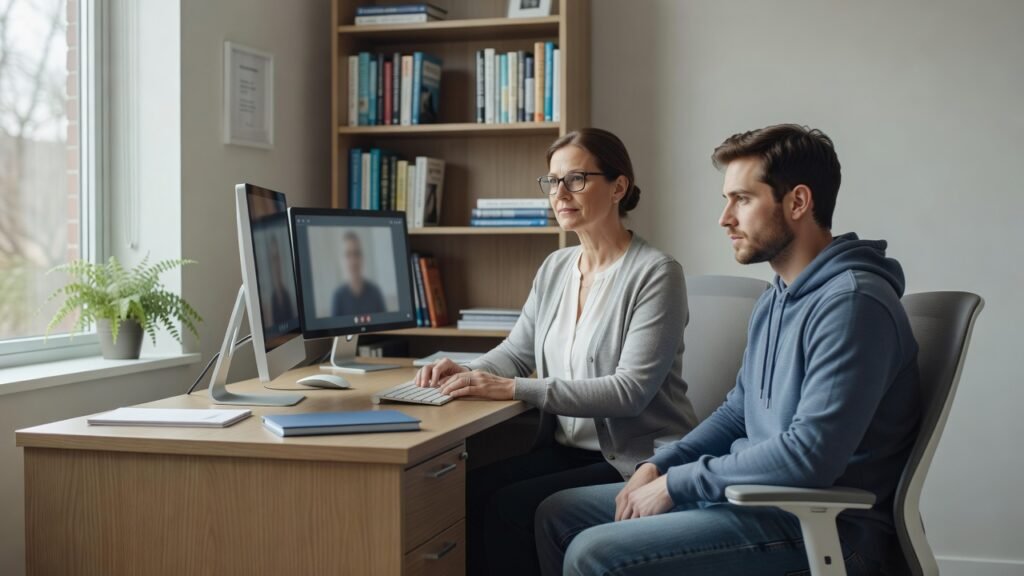
Teletherapy therapy in Long Island NY is fully available to Brentwood residents through New York State Medicaid at no out-of-pocket cost, with first appointments typically scheduled within one to two weeks. Sessions happen via secure video call from home no commute along Crooked Hill Road, no waiting rooms. For most families in Central Islip and Brentwood, this is now the fastest, most accessible mental health option available in 2026.
Key Clinical & Policy Sources
- According to SAMHSA’s 2022 National Survey, approximately 22.8% of U.S. adults experienced mental illness in the past year.
- SAMHSA data shows only 46.2% of U.S. adults with mental illness received treatment in 2022.
- The CDC reports depression affects more than 21 million American adults annually.
The parking lot at Brentwood’s Suffolk County Department of Social Services on Veterans Memorial Highway tells you something about this community — it is full, always. The people here are working hard, commuting on the LIRR, raising children, navigating two and sometimes three jobs. What they often don’t have is a free Tuesday afternoon to sit in a therapist’s waiting room. That’s exactly why teletherapy therapy in Long Island NY has shifted from a pandemic workaround to something our clinical team treats as a permanent, preferred care model for Suffolk County residents.
What Brentwood Families Are Actually Dealing With in 2026
Brentwood is one of the most densely populated communities in Suffolk County, with a largely Latino and working-class population that has historically been underserved by mental health systems. Language access, work schedules, and transportation are real barriers do not excuse. The distance from Brentwood to a well-resourced outpatient mental health clinic in, say, Melville or Hauppauge can take 40 minutes by car and is nearly impossible by bus for someone working until 6 p.m.
According to SAMHSA data, only 46.2% of U.S. adults with mental illness received treatment in 2022 and in communities like Brentwood, where those systemic barriers are stacked, the treatment gap is even steeper. Telehealth changes that math. A parent can attend a session from a parked car, from a break room, or from their kitchen after the kids are in bed. That flexibility isn’t a lesser version of therapy — in many cases, it produces better outcomes because clients are already in their own environment.
🔑 Key Takeaway
Residents of Brentwood, Long Island seeking teletherapy therapy in long island ny can access Medicaid-covered telehealth mental health services in 2026. Our clinical team is available to help navigate enrollment, provider selection, and ongoing care coordination.
What Does a Teletherapy Session Actually Feel Like for a Child or Teen?
This is the question we hear most from parents in the Brentwood area, and it deserves a real answer not reassurance, but a walkthrough of what the experience is like from the patient’s perspective.
For children and adolescents, the first session usually begins with a few minutes of technology setup making sure the camera works, choosing where to sit. Most kids in our practice choose their bedroom. Some sit on their bed with a pillow in their lap. Therapists trained in telehealth know how to read a screen they watch for body language signals that might be subtler over video, like a child pulling back from the camera or shifting their gaze repeatedly toward a door.
The session itself doesn’t feel like a formal office visit. For younger children, therapists often incorporate digital drawing tools, guided storytelling, or screen-shared activity boards. Teens, many of whom are already comfortable with video communication through school and social media, often report that telehealth feels less intimidating than in-person therapy there’s a sense of control over their own space that reduces the power imbalance that can make teenagers shut down in clinical settings.
For a child already dealing with anxiety or school-related stress common presenting issues we see from students attending Brentwood High School or Ross Elementary the ability to be in a familiar space during a session can reduce the activation that sometimes makes in-person intake appointments unproductive.
A Brentwood Family’s Experience: What the Process Looked Like
One family we worked with — a mother of three living off Third Avenue in Brentwood — reached out after her 13-year-old daughter began withdrawing from school activities and experiencing persistent stomach aches with no medical cause. The mother works a morning shift and was skeptical about telehealth. “I thought it was going to be like a phone call,” she told us. “I didn’t think it would be real therapy.”
Her daughter’s first session was scheduled for a Thursday evening at 6:30. She sat in the family’s living room while her mother worked in the kitchen nearby — close enough to feel safe, far enough to give privacy. The therapist spent the first twenty minutes just talking about her favorite shows and what lunch period felt like at school. By the third session, the daughter was discussing the anxiety she felt walking into crowded hallways. By week eight, the stomach aches had reduced significantly, and she had rejoined her school’s art club.
The entire care episode cost the family nothing. Their coverage through New York State Medicaid covered every session. That matters enormously for a household navigating Suffolk County’s cost of living in 2026.
Coverage and Cost: What Medicaid Actually Pays for in Long Island Telehealth
New York State Medicaid covers outpatient mental health services including telehealth therapy sessions, and that coverage applies to individuals enrolled in managed care plans through providers like Fidelis Care, Healthfirst, and MetroPlus — all active in the Brentwood zip codes 11717 and the surrounding 11706 area. New York State expanded Medicaid telehealth coverage permanently following the COVID-19 pandemic, meaning the flexibilities that began as temporary emergency measures are now codified into state policy as of 2026.
For families who are uninsured or in a Medicaid gap, our practice also works with a sliding scale structure. But for the majority of Brentwood residents who qualify for Medicaid — and given Suffolk County’s income demographics, that number is substantial — teletherapy therapy in Long Island NY is genuinely zero-dollar-out-of-pocket care. No copay. No deductible. No billing surprise.
Sessions are typically 45 to 55 minutes. Individual therapy, family therapy, and in some cases group telehealth are all covered service types. Psychiatric evaluation and medication management via telehealth are also available under Medicaid for those who need a higher level of care.
How to Choose a Telehealth Provider That Actually Knows Long Island
Not every telehealth platform is a good fit for Brentwood families. Here’s what we advise when evaluating providers:
- Bilingual capacity matters. A significant portion of Brentwood’s population is Spanish speaking. Ask directly whether licensed Spanish-speaking therapists are on staff — not just “language support” through an interpreter service, which creates clinical distance.
- Medicaid credentialing should be confirmed, not assumed. Ask which managed care plans the provider accepts. Fidelis Care, Healthfirst, and United Healthcare Community Plan are among the most common in Suffolk County.
- Child and adolescent specialization is its own clinical skill. Not every therapist who is licensed in New York has training in pediatric telehealth delivery specifically. Ask about the provider’s experience with school-age children and teens.
- Look for local familiarity. A provider who knows that Brentwood families may be dealing with gang-adjacent community trauma, immigration stress, or economic precarity from the logistics industry that employs many here will deliver more culturally relevant care than one operating from a generic protocol.
Families seeking additional support for children with developmental needs may also find it useful to explore ABA Therapy New Jersey as a regional resource, particularly for families who span the tri-state area. And for those navigating both mental health services and home-based medical needs, Home Care Medicaid NY provides guidance on coordinating Medicaid-funded home services alongside outpatient telehealth care.
What to Expect at Your First Appointment
First appointments are usually structured as an intake or assessment session — not a deep therapeutic dive, but a mutual information exchange. The therapist is learning about the child’s or adult’s current symptoms, history, and goals. The client is getting a feel for the therapist’s style and whether the connection feels safe.
For Brentwood families, we recommend logging in five minutes early to test audio and video. A well-lit room with a closed door makes a real difference in the quality of connection — both technical and relational. Most platforms we use are browser-based and don’t require any app download.
After the intake, a treatment plan is typically developed collaboratively within the first two to three sessions. This plan outlines session frequency (usually weekly to start), treatment goals, and any coordination with schools or pediatric providers that might be needed.
The CDC reports depression affects more than 21 million American adults annually, and anxiety disorders affect an estimated 40 million adults in the United States yet the American Psychiatric Association reports that 75% of people with mental illness do not seek treatment. For many Brentwood residents, the moment telehealth removed the transportation, and scheduling barrier was the moment care finally became reachable.
Frequently Asked Questions About Teletherapy Therapy in Long Island NY
My child has never done therapy before and is nervous about being on camera — is that normal, and how do therapists handle it?
Completely normal. Camera-shyness is especially common in preteens and children who associate video calls with school presentations or formal settings. Our clinicians are trained to let the child lead the pace in early sessions — if a child wants to keep their camera off for the first few minutes while they get comfortable, that’s a valid clinical decision, not a problem. Most children relax within the first ten to fifteen minutes once they realize the therapist is genuinely curious about them, not evaluating or grading them. By session two or three, most kids are the ones who don’t want to hang up.
Does Medicaid in Suffolk County cover teletherapy for both children and adults, or just one group?
Medicaid telehealth coverage in New York applies to both children and adults, with no age cutoff. Children enrolled in Child Health Plus (New York’s Medicaid expansion for kids) are also eligible for telehealth therapy services. In practice, this means a Brentwood parent and their teenager can both receive individual telehealth therapy under the same household Medicaid coverage without separate authorization processes. Family therapy sessions where a therapist works with both parent and child together — are also a covered modality.
What if we live in Brentwood but one parent works in Queens or Brooklyn — can we still use a Long Island-based telehealth provider?
Yes. New York State telehealth rules allow any licensed New York clinician to provide services to any New York resident regardless of county. The provider must be licensed in New York State, and the client must be physically located in New York during the session — but that location doesn’t have to match the provider’s office county. A parent who works in Crown Heights during the day can have a session from their Brooklyn office on a lunch break while the child has their own session from home in Brentwood. The logistics of modern telehealth are genuinely that flexible.
Related: Telehealth Medicaid Therapy Services — learn how virtual sessions are covered under New York Medicaid.
Related from Medicaid Therapy Online: Anxiety Therapy via Video for Astoria, Queens Residents · Virtual Counseling in Long Island NY